

The ongoing conflict in the Middle East and the geopolitical tensions surrounding it have led to economic uncertainty.
Inflation is likely to remain elevated in many regions, economic growth forecasts have been revised down, and markets have experienced volatility.
However, it’s important to remember that the world has, unfortunately, seen events such as these before. And despite short-term dips in performance, markets have continued to grow over the long term and remain resilient in the face of crises.
Indeed, amid rising inflation and slow growth, the market often offers the most effective route for securing your wealth over time.
Read on to find out about the importance of remaining calm amid market volatility.
Market downturns happen more often than you might think, and exiting is typically a bad idea
Short-term downturns and volatility are a normal part of the journey to long-term growth, and it’s important to understand just how frequent significant dips are along the way.
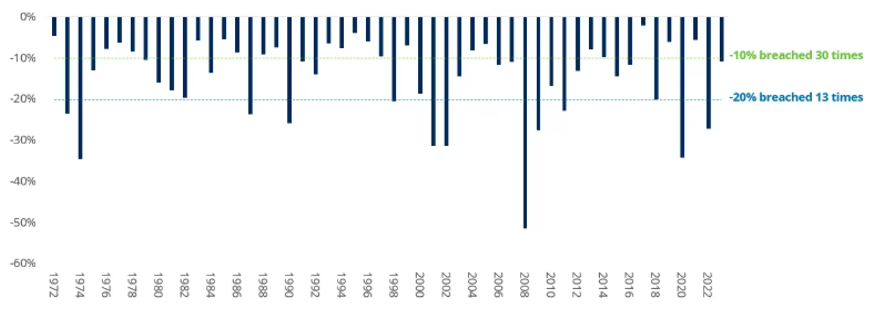
Schroders analysed the performance of the MSCI World Index between 1971 and 2023 and found that there were double-digit falls in more years than not – as you can see in the graph below.
Source: Schroders
The data revealed that dips of at least 10% occurred in 30 of the 52 years they studied, while falls of 20% or more happened in 13 years. Despite this, the MSCI World Index has continued to grow over the long term.
To put that into the context of the current conflict, the FTSE 100 fell by around 10% within the first few weeks and has continued to experience volatility as the situation unfolds.
When markets dip in this way, it can be unsettling, and your initial reaction may be to sell off and cut your losses. However, doing so is typically not a good long-term decision.
The analysis from Schroders also looked at some of the biggest market crashes over the past hundred years. It found that selling after significant declines consistently led to longer recovery times.
For instance, during the 1929 Wall Street Crash, an investor who switched to cash after the market had fallen 25% would not have broken even again until the 1960s. By contrast, someone who stayed invested would have recovered their losses nearly two decades earlier, by the mid-1940s.
Similarly, investors who sold after the initial 25% drop during the 2008 Financial Crisis still hadn’t recovered their losses when the research was conducted in 2024. Meanwhile, those who remained invested would have recovered within around five years.
So, while market downturns can feel scary, it’s important to remember they are not out of the ordinary and selling off is often the worst thing you can do.
The key principles of financial planning can help you weather volatility and crises
When markets are volatile and global tensions dominate the headlines, it can be difficult to look at the bigger picture.
But the fundamentals of financial planning don’t change and can be key to helping you through difficult periods. These include remaining focused on long-term trends, rather than reacting to short-term market movements, and maintaining a well-diversified portfolio to help you weather challenging conditions.
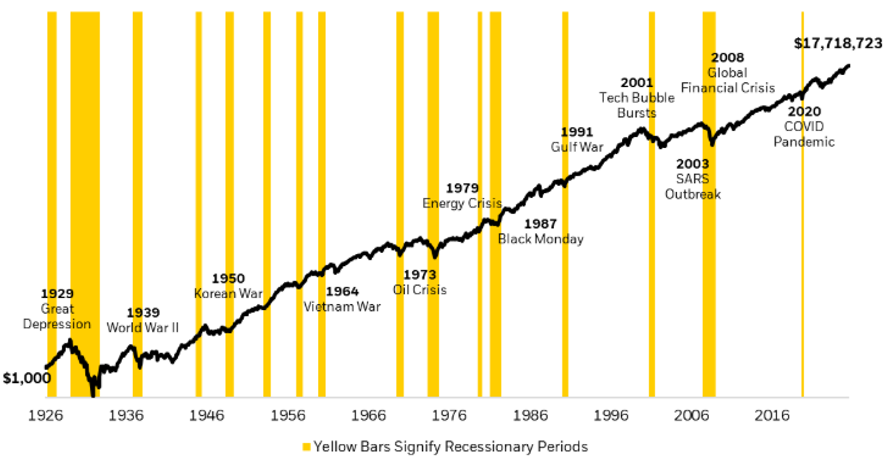
The graph below shows the growth of $1,000 invested in the US stock market from 1926 until January 2026, alongside significant events that triggered recessions along the way.
Source: iShares
As you can see, despite the dips and recessions, the $1,000 investment would be worth over $17 million by January 2026.
However, market dips can still be unnerving in the short term, which is where diversification can play a role. Portfolio diversification is one of the most reliable ways to manage risk and periods of market volatility.
Holding too much of your wealth in a single sector, region, or asset class can leave your portfolio vulnerable if that area struggles. Conversely, spreading your investments helps reduce concentration and can make your overall returns smoother and more resilient over time.
While some parts of your portfolio may fall in value during certain periods, gains in other areas can help balance the impact, creating a steadier path towards long-term growth.
A financial planner can help ensure you are prepared for periods of volatility
Market downturns amid global tensions can be worrying, but history shows that reacting to such moments hasn’t offered the best path to recovery. Rather, it’s important to have a long-term plan in place to accommodate challenging periods along the way.
A financial planner can help you create a well-diversified plan built around your long-term goals, rather than short-term movements. They can also provide reassurance and experience during periods of uncertainty and help ensure you understand the bigger picture beyond the current headlines.
To speak to a financial planner, get in touch.
Email contact@ambient-wm.com or call us on +34 658 077 450.
Please note
This article is for general information only and does not constitute advice. The information is aimed at individuals only.
All information is correct at the time of writing and is subject to change in the future.
The value of your investments (and any income from them) can go down as well as up and you may not get back the full amount you invested. Past performance is not a reliable indicator of future performance.